The Burk Family: A Two-Village Legacy
The Burk Family:
A Two-Village Legacy
Parry Sound Life Magazine: By Andrew Hind - Tuesday, December 30, 2025
It’s rare for a family to be able to proclaim their forebearers founded a community. Even rarer is the family that can claim to have founded two. The Burks accomplished this in the District of Parry Sound — Burk’s Falls, which they’re best known for, and also the town of Seguin Falls.
Pioneering was in the Burks’ blood. John Burk, born in 1754 to Irish immigrants, moved to the young and largely unsettled Upper Canada in 1794, accepting the invitation of free land to those who’d remained loyal during the American Revolution. He was among the early wave of settlers in Darlington Mills, now part of Bowmanville. The story of the Parry Sound Burks begins with John’s grandson, David Francis Jr., often called David the Younger.
Born Aug. 4, 1823, David the Younger likely grew up hearing about his grandfather’s Darlington hotel and how profitable roadside inns could be. It would play a role in his future.
David had three children with his first wife, Pernilla, who died in 1860 — sons David Francis III (Frank) and Frederick William, and daughter Jane. His second wife, Henrietta Taaffe, nine years his junior, would be a constant companion for the rest of his life and an equal partner in pioneering Parry Sound.
Around 1869, David decided to uproot his family from the comforts of southern Ontario and take them to the wilderness of Parry Sound District. Starting anew wasn’t completely a blind leap of faith. David had a plan. As a result of his upbringing, he knew the importance of roadside inns and had that in mind when selecting lots 28 and 29, Concession B, Monteith Township, for his land. It just so happened that this property straddled the still-under-construction Nipissing Colonization Road. Eventually stretching 67 miles (108 kilometres) from Lake Rosseau in the south to Lake Nipissing in the north, this road would become a highway of sorts for this vast region. David planned to profit from the steady flow of traffic by building a hotel.
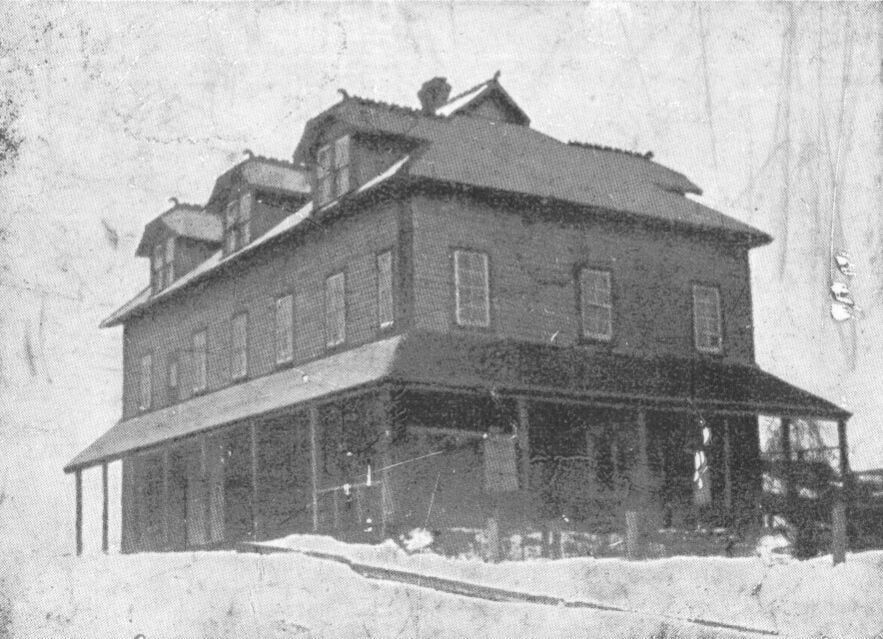
This Seguin Falls hotel was a fine establishment that stood three storeys high and boasted a well-appointed dining room, a parlour and probably a dozen guest rooms. As a devout Methodist and teetotaller, David designated his establishment a “temperance hotel” — one that didn’t permit the consumption of alcohol. It gained a wide reputation for its conviviality.
“The traveller will find an excellent temperance hotel at Seguin Falls, the proprietor of which, Mr. D.F. Burk, is a most genial and hospitable host,” wrote the “Guide and Atlas of Muskoka and Parry Sound Districts for 1879.” “Nor should we forget to praise the excellent cuisine of his good lady.”
The hotel thrived and literally put the spot on the map. In its shadow, the village of Seguin Falls took root. The community grew to include a church, Adam Fitzer’s store and blacksmith shop, a sawmill run by the Guelph Lumber Co., and a school. David wrangled an appointment as postmaster and operated it out of the hotel.
David didn’t live long enough to see the village grow. He died on Dec. 11, 1879. Less than a year later, Henrietta married William Edwards of Toronto, hired Henry Pletzer to run the hotel, and then moved to Toronto with her new husband.
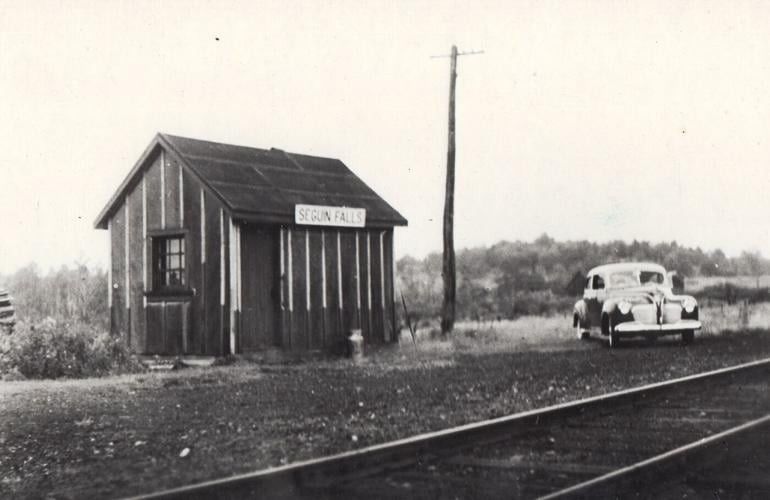
The hotel continued for a time under Pletzer. It’s uncertain when the business closed, but in 1897, Seguin Falls relocated several miles south, astride the newly laid railway tracks, and new hotels sprang up there. To compound the original hotel’s pain, Nipissing Road traffic was dwindling. In 1901, Henrietta sold the property — no mention of a hotel by then — to James Vigrass. It seems likely that the business closed sometime in the late 1890s.
But the demise of the hotel in Seguin Falls didn’t mark the end of the Burk saga in Parry Sound District. David Francis III (Frank) would carry on the family tradition of pioneering and operating hotels.
In 1875, when Frank was 24 years old and ambitious, he ventured north to the Magnetawan River and paddled upstream in search of land to call his own. Tradition says during the October voyage he became the first settler to see the cascading waters at what would later become Burk’s Falls. True or not, Frank was impressed. He knew that waterfalls were valuable for powering sawmills and gristmills, foundations upon which 19th-century civilization depended, so he staked claim to the land bordering the falls. Other land-hungry settlers soon joined him, and farms sprouted amid the dense forests.
Controversy emerged when it came time to name the waterfall. Frank felt the falls should be named in his honour, but Henry Knight, who had arrived shortly after Frank, wanted the honour for himself. Both men were proud, but recognized that in a region where merely surviving was the priority, the matter of a name was almost trivial. Like true gentlemen, they settled the debate with a flip of a coin. The falls, and later the settlement, became known as Burk’s Falls.
Emulating his father, Frank built a hotel. Also like his father, he secured the lucrative position of postmaster. In addition to providing hospitality and mail, Burk’s Hotel also served as a general store and even a place of worship before dedicated churches were built.
It wasn’t long before much of the clientele shifted from travellers to tourists, particularly sportsmen looking to fish and hunt. Pains were taken to keep the hotel up to date with the latest comforts. An ad from the 1890s noted that this “commodious tourist’s hotel” was outfitted with electric bells throughout, telephone connection and first-class accommodation. While all this was happening, Frank and his wife Alice added three children — Mabel, Ida and Walter — to their family.
The turn of the century saw Frank and his hotel in their prime, but neither was fated to last the decade. Frank died on June 13, 1901, aged 49. Alice was still in mourning when 24-year-old Walter died on Aug. 24, 1902, in some unspecified accident. She leased the business, moved to Toronto, then sold it outright in 1906.
Two years later, the hotel was gone. On June 20, 1908, a fire started in the drying kiln of the Knight Bros. sash and door factory. Fanned by strong winds, the flames erupted into an inferno that spread throughout the village. At the end of the day, when the flames had finally subsided and the smoke cleared enough for residents to take stock of their losses, a grim picture emerged. More than two dozen buildings had been reduced to ash. Burk’s Hotel was among them. It was never rebuilt.
David Francis Burk Jr. and son Frank were ambitious, visionary men and both saw hotels as vehicles that would deliver them prosperity. Wealth eluded them, as it did many others who tied their dreams to Parry Sound, yet they cemented the family legacy with the unique honour of founding not one, but two communities.
Source: https://www.parrysound.com/news/pslife-burk-famiy/article_581a7059-9860-57dd-83f2-968fbede9030.html